TradeLanes Booking Data API (1.0.0)
Read-only access to the ocean bookings your account tracks with TradeLanes: the origin dates (ERD, CY cutoff, documentation cutoff, ETD, ATD) and the carrier's ETA to the final port of discharge, for every booking, from each carrier's own data feeds.
We issue one key per account. It reads only your account's bookings. Send it in the Authorization header on every request:
Authorization: Bearer tlk_xxxxxxxxxxxx_xxxxxxxxxxxxxxxxxxxxxxxxxxxxxxxxxxxxxxxxxxx
Keep the key out of source code, tickets and shared drives. If it is exposed, tell us and we will revoke it and issue a new one. A revoked key stops working within five minutes.
Call the list endpoint once a day with updatedSince set to the time of your last successful run, and follow nextCursor until it is null:
CURSOR=""
while : ; do
  PAGE=$(curl -s "$BASE_URL/v1/bookings?updatedSince=2026-11-24T06:00:00Z&limit=200${CURSOR:+&cursor=$CURSOR}" \
    -H "Authorization: Bearer $TRADELANES_API_KEY")
  echo "$PAGE" | jq -c '.bookings[]'
  CURSOR=$(echo "$PAGE" | jq -r '.nextCursor // empty')
  [ -z "$CURSOR" ] && break
done
updatedSince returns bookings created, or with a schedule change applied, since that time. Store the start time of each run and pass it as updatedSince on the next one.
Schedule dates (erd, cyCutoff, docCutoff, etd, atd, portOfDischargeEta) are the local time at the port, exactly as the carrier or terminal publishes them, as YYYY-MM-DDTHH:mm with no time zone. Every booking says so in timeBasis (port_local_wall_clock). Do not convert them from UTC: they are not UTC.
createdAt and lastCheckedAt are instants in UTC (ISO 8601 with Z).
Carriers do not agree on what "arrival" is. portOfDischargeEta is the carrier's own estimate for the final port of discharge, and portOfDischargeEtaEvent says which event it refers to:
| Value | The carrier's ETA is for |
|---|---|
vessel_arrived | The vessel arriving at the port |
vessel_berthed | The vessel berthing at the terminal |
container_arrived | The container arriving at the last terminal |
carrier_eta | The carrier's ETA, event not specified |
For the same sailing, a carrier that reports berthing can show a date days after one that reports arrival at the port.
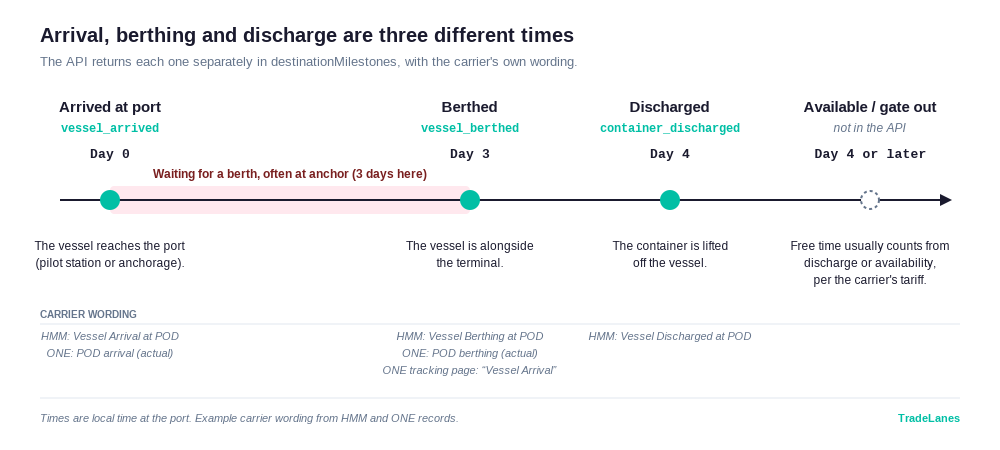
destinationMilestones carries the vessel's arrival and berthing at the final port and each container's discharge, from the ocean carrier's own record. Each entry has the carrier's latest estimate, the actual time once the carrier reports it, and the carrier's own wording for the event.
- One entry per container and event.
containerNumberisnullwhen the carrier reports the event for the whole booking without naming a container. - Times are local time at the port, like the schedule dates. When the carrier gives only a date, the value is
YYYY-MM-DD. - The list is empty until the carrier reports the first of these events for the booking. Some carriers do not report every event (for example berthing).
Up to 5 requests per second (bursts of 10). Errors return JSON with an error message that says what to fix. 429 means slow down and retry; 500 means our side, retry later.